Lindell, Kansas · The drought of 1893
The Driller Who Could Read the Ground
The Rich Rancher Laughed at His Hands… Then the Dry Creek Ran Clear
The richest rancher in the county mocked his hands in front of the whole church social and hired a water witch instead. Then the witch's hole went dry at ninety feet, and the town's water was making people sick.
- 16:09Runtime
- 1893Lindell, Kansas
- 6Chapters
- FreeOn YouTube
Meet the crew
Who's on the span
-
The Driller
Dell Pruitt 44
The sand says not yet. We are close, Ruth. I can feel the bit change its note.
- Strength
- Reads sand, shale and spoil by hand
- Flaw
- Would rather be laughed at than argue
-
The Committee
Ruth Halvorsen 34
He can call it what he likes. He is not the one who is thirsty.
- Strength
- Knows every family's need
- Flaw
- Never asks anyone for help
-
The Cattleman
Hollis Barr 60
Here is a man who digs holes for a living, and his hands show it.
- Strength
- Holds the town's loans in his head
- Flaw
- Has to be right in public
-
The Water Witch
Josiah Crane 58
A forked hazel stick and a show of confidence, with no ground under it.
- Strength
- Sounds certain
- Flaw
- Nothing under the stick
Read it first
The story in 6 chapters
00The history behind it
The drought behind the story is real. The years from 1893 to 1895 were the driest yet recorded on the central Great Plains, and western Kansas took them hard. Crops burned up in the hot winds, and families who had come out believing that rain would follow the plow watched their wells and creeks fail. Many sold out or simply left. The towns that stayed hauled water from whatever still ran.
The sickness that follows a failing creek is typhoid, which spreads through food and water fouled with the germ that causes it. That germ had been identified in the early 1880s, and a careful doctor of 1893 knew a fouled source was dangerous and that boiling helped. But when a whole town drank from one shrinking creek, there was little he could do. The fever could lay a household low for weeks, and the people nursing the sick were often the ones who most needed to be working.
Cable-tool drilling was what a driller of that day brought with him. A heavy bit hung on a cable from a wooden derrick and was lifted and dropped, over and over, pounding through clay, sand and shale a little at a time. A big rig had a steam engine to work it; a small one was worked by hand with a springy pole. Every few feet the driller ran down the bailer, a long tube with a valve in its foot, to bring up the cuttings, and a good driller read the ground from what came up. The method grew up in the Pennsylvania oil fields after the first wells there in 1859, and men trained in those fields carried it west.
Water witching was common across the plains. The witch walked the ground holding a forked stick and marked the spot where it dipped, and plenty of landowners paid for the service. Careful tests have never shown that dowsing finds water better than chance. Lindell, its people and its well are made up for the telling; the dry years, the fever, the cable rigs and the forked sticks are the real record of the plains.
01Dry Creek Country
In the summer of 1893 the rain stopped over western Kansas and did not come back. The buffalo grass went the color of old straw, the sod roofs cracked along their seams, and the little town of Lindell sat on its bench of limestone with its wells gone dry and its eyes fixed on the creek. Most folks had stopped expecting rain at all.
Ruth Halvorsen hauled water into town every morning from the creek, two barrels lashed to a flatbed behind her father's old mule. She had watched the creek shrink through June and July until it was a chain of green pools in the bottom of a wide gray bed. By August those pools smelled of rot, and the water she dipped came up cloudy, with a skin of scum she skimmed off with a tin cup.
By the second week of August the fever had come into town. A family on the east side took to their beds with burning heads and bad bellies, then two more households followed. Doctor Lyman boiled everything he could boil and sent word to the relief committee that he could not keep up. Every family that could walk was carrying creek water, and every family knew what it was doing to them.
Ruth chaired the relief committee, which in a town this size meant she wrote the letters nobody else wanted to write. She wrote to the railroad agent at Garden City and asked whether any well man could be spared for a week. The answer came back on the Thursday freight: a cable-tool driller named Dell Pruitt, forty-four years old, late of the Pennsylvania oil fields, willing to come for sixty dollars and his board.
Hollis Barr, who held most of the good grass north of the creek, had already sent for a water witch of his own. Josiah Crane had come out from Wichita on the same freight, carrying a forked hazel stick and a notebook full of ruled maps. Barr gave him a dollar an hour and a bed in the Barr house. Barr trusted his own money, and whatever Crane could divine out of the earth.
Dell Pruitt climbed down from the freight car with his hat pulled low against the glare. He was lean and sun-cured, with grey stubble and a driller's hands, the knuckles split and healed white from years of hauling iron. His helper Eli Tanner came behind with the sample jars. Dell looked at the dry creek a long moment before he spoke. "Creek's the wrong place to look," he said. "Show me where the wells used to be."
03The Tailings Pile
The spoil heap sat on the south fence line, twenty feet across, where Barr's hired men had bored down forty feet with a hand auger and quit. The earth had dried and crusted in the sun. Dell walked around it once, slowly, the way he walked around any hole he meant to read. Eli trailed after him with the crate. A hawk turned over the grass, and the wind rattled the fence wire.
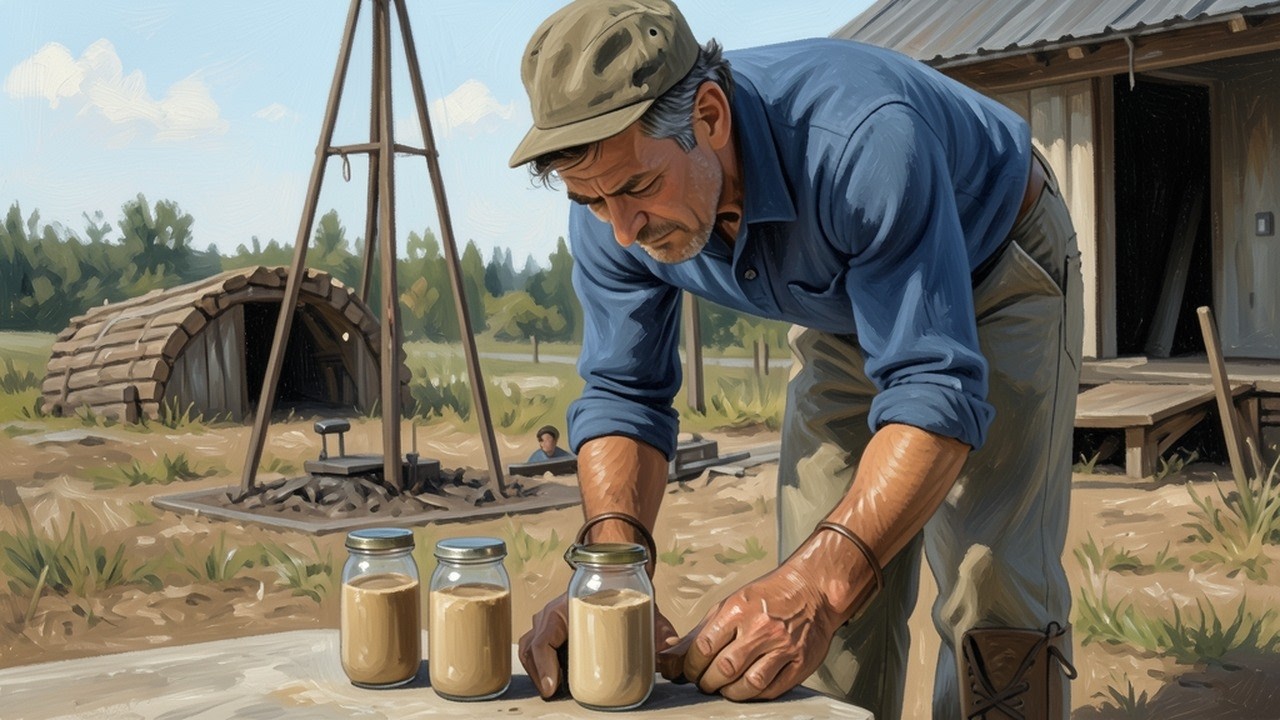
Dell took a sampling scoop from his coat and dug into the pile at three heights, where the auger had brought up earth from different depths. Eli called out each depth from the marks on the auger rod. Each scoop went into a clean sample jar with a strip of tape on it. He worked without hurry, the way a doctor takes a pulse.
At each jar he took a pinch of the damp sand and rubbed it between his thumb and first finger. Clay stuck and smeared into a grey paste. Shale felt gritty and flat. Water-bearing sand slid apart, cool and loose, the grains rolling like fine sugar. Two of the jars were mostly grey clay. The third ran yellow-grey, fine to medium, and it felt alive.
He poured creek water into each jar, shook it hard, and set it on a flat stone to settle. The clay jars clouded and stayed clouded. The yellow-grey jar cleared in a few minutes, the sand dropping into a neat, sorted bed while the water above it went bright. Dell read the line of clear water the way another man reads a letter. The auger had stopped a few feet short of the bed.
He turned to the shale in the wall of the old creek cut and read the color of it like a page. Above a band of hard, pale sandstone the shale ran grey, and where the stone had been cut and filled again, the shale went darker and the sand came back loose. That was an old creek, buried under the sod, running on a bend the surface had long forgotten.
That evening, by lantern light at the Halvorsen kitchen table, Dell sketched the buried channel on the back of a feed-store bill. He drew the creek bend, the cut in the stone, and the line where the old course ran east of the dry bed, and from the depth of the shale cut and the sweep of the bend he reckoned the water sand lay near a hundred and eighty feet down. Ruth came to the door with a plate of bread and stopped to look. "It runs under your claim," he said. "It doesn't care whose fence it crosses."
04Ninety Feet of Dust
Barr would not wait for a city man. Crane's hired men moved their auger and pipe to the spot marked with the X, two hundred yards north of the old creek, and bored it by the witch's bearings from sunup to dusk. At ninety feet the auger came up dry. Another day brought up only blue clay. Barr stood at the edge of the pit with his hat in his hand and said nothing at all.
By the first week of September the creek had turned. The green pools went black and sour, and the stink carried up the bench to the church. Hogs on the lower place died in the mud. The store's cisterns ran empty, and the last clean barrels were rationed out by the cup. The fever moved house to house, the way a slow spill spreads over a floor.
Abigail Greer came to the store with her hands shaking. Her husband lay flat with fever, and she had three children to feed on a cup of water a day. Ruth gave her the last clean barrel from the Halvorsen cellar, then walked straight to the committee room, where the minutes were already full of names. She wrote the new names down without stopping.
Ruth went up to Barr's porch and asked him to let Dell drill one hole on his north pasture. Barr heard her out and shook his head. "My witch found my water," he said, "and it came up dry. I will not have a city digger tearing up my land on the word of a homesteader's girl." He shut the door. Ruth stood on the steps and felt the heat of the boards.
That night Ruth came to Dell's lamp at the boarding house with her father's deed folded in her apron. "The claim lies east of the dry bed," she said. "You drew the bend. You know where it runs. Barr will call this my pride," she said. "He can call it what he likes. He is not the one who is thirsty." Dell read the deed under the lamp, then looked at her across the table for a long time.
Eli came in from the yard, heard the decision, and grinned until he saw Dell's face. "It's a hundred-and-eighty-foot hole," Eli said. "Cable tool, no steam, no pumps to spare. That's weeks of work if the bit holds." "Then we'll make it fast," Dell said. "Rig the derrick before light. Pack every jar. And when I say bail, you bail, every foot. I won't have a single cut skipped."
05A Foot at a Time
They raised the wooden derrick on the Halvorsen claim, a tripod of pine poles lashed at the top, with a walking beam and a sheave for the drilling cable. Dell hung the string from the cable: the heavy bit, the drill stem, and the drilling jars, long steel links that could be struck to free a stuck tool. He tested each link with his palm and listened to the ring, the way a man listens to a bell.
The walking beam rose and fell, and the bit dropped on its cable, pounding the rock to powder a few inches at a time. Every stroke sounded different in sandstone than in shale. Dell kept his hand on the cable line and felt each change through his palm. A soft ring meant the shale was going, and a dead thud meant hard stone. He called each change to Eli without looking up.
Every foot, the drilling stopped and the bailer went down. It was a long steel tube with a valve in the bottom, and it came back up full of wet cuttings and muddy water. Eli hauled it over the edge and tipped it into a pan. Dell took a scoop of the wet sand, rubbed it between his fingers, poured it into a jar of creek water, and set the jar on a stone to settle.
He read each jar the way he had read the tailings. Grey clay clouded the water and stayed clouded. Gritty shale dropped fast and left the water murky. Fine yellow-grey sand settled in neat layers and let the water clear. He wrote the depth beside each jar in pencil, and by the sixtieth foot the notes ran down a column that Ruth could read from across the yard.
Dark settled over the claim, the derrick a black shape against the stars. Ruth brought coffee in a tin pail and sat on an upturned crate beside the lamp, holding up the jars one after another so Dell could see the layers. "Tell me what they say," she said. "The clay says no," Dell told her. "The sand says not yet. We are close, Ruth. I can feel the bit change its note." Before she went back down the slope, she asked him something no one had asked him in a long time. "Not what the town needs," she said. "What do you want from this well?" He thought about it a long while. "A dry creek running again," he said at last, "and a crew that stays to the end." She laughed, low and surprised, and did not hide it.
At the hundred-and-forty-foot mark the cable went slack and the bit stuck fast in the rock. Eli swore and hauled, and the bailer came up empty. Dell did not curse. He worked the drilling jars, a sharp blow up and then a long pull, until the bit broke free with a crack that rang out over the prairie. They lost half a day to it, and Eli wanted to quit. Dell did not let him.
At one hundred and eighty feet the bailer came up heavy. Eli hauled it over the edge with both arms, and the valve was packed with wet, dark sand that dripped from every seam. Dell caught the first drops in his palm. They were cold, and the sand slid apart in his fingers like fine wet sugar. He stood up slowly and told Ruth to come and look.
06The Water on the Bench
Three weeks later the town met again in the Methodist hall, the same room, the same lanterns, the same piano against the same wall. The committee had called the meeting to hear the well report. Hollis Barr came early and took the front row with his arms folded. The people who had laughed on the night of the social came in and found their seats without a word. Josiah Crane stood against the back wall with his forked hazel stick under one arm. Ruth Halvorsen stood up front and read the well report herself, in the same clear voice she had used to write to the railroad agent, and the room heard every word of it.
Dell stood at the front holding a fruit jar. It had been filled from the Halvorsen pump that morning, and the water in it was clear as glass. He did not make a speech. He set the jar on the table beside the lectern. Josiah Crane came up from the back wall and unfolded the ruled map of Barr's north pasture, the same sheet Barr had passed hand to hand at the social, and laid it down beside the jar with the X and the bearings in plain view. Then he went back to the wall without a word. Dell picked the jar up again and held it out to the nearest man in the front row, who looked through it and passed it on. The jar went from hand to hand down the aisle, past the quilts and the children, to the back wall.
Abigail Greer took the jar at the back and drank the first clean water she had tasted in a month. She wiped her mouth with the back of her hand and began to cry, quietly, and no one in the room said a word. Then a murmur started at the back and moved forward, a sound that was not quite a cheer. Dell waited for it to finish.
Hollis Barr rose slowly. He looked at the empty jar in the last pair of hands and at the man who had carried it, and for a long while he said nothing. Then he took off his hat and told the whole room that he had been wrong, and that his witch had cost the town three weeks it could not spare. He would pay for the casing, the pump and the well house.
"Mr. Pruitt," Barr said, and the stiffness of the words hung in the hall. "I said your hands show it, and I was wrong. They are the best thing I have seen in this county." Dell nodded once and took the old man's offered hand. Barr's grip was hard, and it did not let go too quickly. Neither of them smiled. At the side of the room, Ruth looked at the floor and let herself breathe.
The committee voted before the coffee was poured. The new well would be called the Halvorsen Well, after Anders Halvorsen, the homesteader who had first farmed this bench and who had died the winter before. The town would fill its barrels there for as long as the water held. Ruth heard the name read out and held very still, and this time she did not hide her tears.
In October Dell and Ruth were married on the claim, under the new derrick, with the well house finished and the pump handle painted white. Eli stood up for the groom and did not sit down until the preacher told him to. The Greer children carried the cake from the wagon. Hollis Barr sent a case of tinned peaches and a letter in stiff copperplate that nobody on the bench had expected him to write. Dell still keeps the sand jars in the store cellar, each one labeled in pencil with its depth. When a stranger laughs at his hands, he only smiles and tells him to come and draw a bucket. Each evening Ruth works the pump handle, and the water comes up cold and clear.
Lindell, Kansas · The drought of 1893
The Driller Who Could Read the Ground
Watch the full story16:09 · free on YouTube · no sign-up